United States
The Glass RoomThe United States functions in the novel both as a destination of refuge and as an idealized future, a place imagined as still building while Europe destroys itself. For the Landauers, departure toward it is neither a simple liberation nor a clean break with the past: the journey carries the loss of their home, the uncertainty of refugee status, and the family’s exposure to border officials’ discretion. The promise of a new world remains vivid, but the events at the station show how easily a family can be divided on the way there.
An American future
Rainer von Abt presents the United States as the next stage of his life after Europe. He refuses the work offered to him by the German government, including the proposal that he design entire towns, and says that when his current work is finished he will go to America. A university there has offered him a post at the Michigan Institute for Science and Technology, whose acronym he turns into a joke about the country’s muddled promise. The position would involve redesigning the campus. To Liesel, his plans offer a sense of possibility: he speaks of steel, glass, light, volume, and buildings rising so high that clouds hide their summits. Against the destruction under way in Europe, America appears to be building.
That promise has limits. Liesel tells Rainer that the Landauer House has been taken because Viktor is Jewish, and she cannot treat a new destination as though it erased that dispossession. In exile, she feels that she does not belong where she is. Viktor calls himself a citizen of the world and talks about going to the United States, but Liesel misses home and friends and worries about the practical barriers: they have neither work nor relatives there, and immigration quotas constrain their prospects. Viktor suggests Cuba as a possible route, but Liesel doubts that it is a destination anyone in the family would choose. America is imaginable as refuge, not yet assured as a place where they can settle.
Memory against departure
As the family prepares to leave, Viktor turns the journey into a confident narrative of renewal. He urges immediate preparation and proposes moving near Geneva while they wait for confirmed train tickets. America, he says, offers a better prospect than the old continent; they can leave behind Europe’s memories and conflicts. His repeated use of Goethe’s words recalls their honeymoon, when he first quoted the poem and their future had seemed settled. The allusion gives his present optimism a personal history, but it also sharpens the difference between the couple’s responses to departure.
Liesel questions whether memories can really be called useless when they are all that remain. Her doubt is bound to the particular rooms and routines of the home they have lost. She recalls reconstructing the house in dreams, walking its terrace and entering the children’s rooms, including the bathroom marked by rubber ducks. The Glass Room, with its twelve steps to the curve and nine more down into the space, is not simply an architectural object in her memory; it is a place where the family was happy. Against Viktor’s faith in the future, the measured details of her imagined walk make the past physically present. She even doubts that the future he invokes is benign: in their old house, anthropology and race have become part of the future’s reality.
The border and the fragile passage
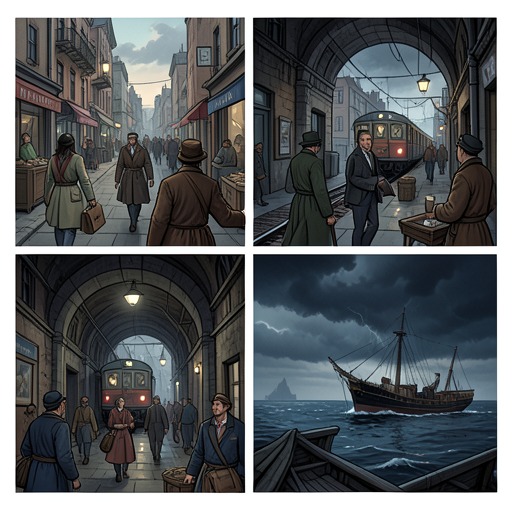
The family’s route toward the United States passes through a system of borders and documents that makes escape conditional at every stage. Liesel had already found it ironic that a world supposedly moving forward had created a new border control where none had existed before. At a later checkpoint, the family waits while officials inspect passengers’ papers and soldiers remove some people from the train. Rumors spread that travelers without documents have been caught. Relief when others pass is mixed with the fear that the next family may fail the test.
Viktor lays out the group’s documents in neat piles and identifies the travelers as himself, his wife, their two children, their nanny, and the nanny’s daughter. Passports, French transit visas, and a Spanish visa are examined, followed by the tickets. The orderly display makes passage look like a matter of proper paperwork, but the scene keeps the stakes visible: those papers must satisfy officials who can stop the journey. Katalin’s case exposes the gap between possessing documents and being allowed through. When an official questions her, Viktor says that she is in their employ; the soldier rebukes him for speaking without being asked. After consultation, another uniformed figure leads Katalin toward a hut. Marika cries out for her mother, and Liesel pulls the girl close, promising that she is with the family and will be looked after.
The separation becomes more severe when Marika is also led toward the hut. Katalin looks back desperately and calls to Viktor, who protests that her papers are in order and that she is travelling on a Nansen passport. The official tells him to return to the train or risk detention. Viktor insists that the passport and visas were accepted for entry into France and Spain, but the moving crowd presses onward, eager not to attract attention or become the next unlucky travelers. The official advises Viktor to move on and suggests the delay may be temporary; a soldier takes Katalin’s and Marika’s suitcases. Their detention demonstrates that a refugee passport and valid-looking visas do not guarantee movement when border authorities hold the power to decide whose papers count.
Departure and unresolved meaning
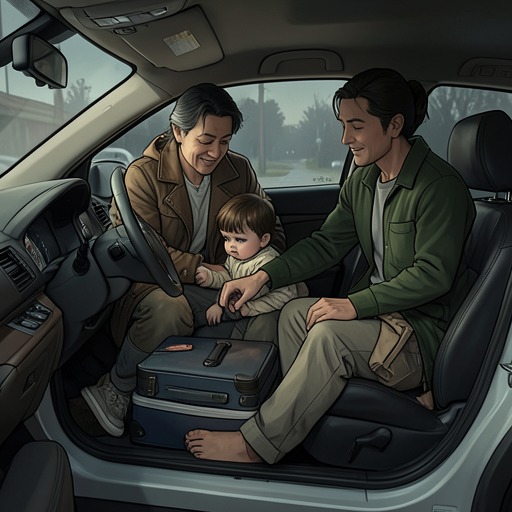
The family’s eventual departure gives the American destination a concrete, if still idealized, form. In the last photograph made at the villa, Viktor wears a lightweight suit and a Panama hat; Liesel wears a floral dress and a straw hat that does not shade her eyes. The children wear broad-brimmed straw hats, and Martin’s attention is caught by a lizard crossing the veranda. Once the camera has been put away, a car waits to take them to the port and the flying boat that will carry them toward the promised land and the future. The photographic image fixes the travelers at the point of departure, before the crossing can be resolved into a settled life.
The United States therefore remains a destination more than a completed homecoming in reverse. Viktor imagines it as a release from Europe’s conflicts and useless memories; Liesel’s attachment to the house makes that clean break impossible, while the detention of Katalin and Marika reveals the human vulnerability concealed by the language of travel documents and onward passage. The departure points forward, but the novel’s emphasis on memory and interrupted movement prevents the future from cancelling what has been lost or guaranteeing that everyone will reach it together.